Documentation

​
​

Development

User Acquisition

Monetization

Industry

Asset Transformer Studio

2026.5.0

Supported
​

User Manual

Python API

Changelog

Asset Transformer Studio

2026.5.0

Supported
​

​
​
Get started
  • About Asset Transformer Studio
  • Getting started
  • Additional Resources
User Interface
  • Overview
  • Menu Bar
    • File Menu
    • Edit Menu
    • Create Menu
    • Selection Menu
    • Scene Menu
    • Materials Menu
    • CAD Menu
    • Mesh Menu
    • Optimize Mesh Menu
      • Generate LOD Chain
    • Point Cloud Menu
    • UVs Menu
    • Window Menu
    • Plugins Menu
    • Help Menu
  • Toolbars
  • Window
  • Customizing the User Interface
Data Preparation Fundamentals
  • Overview
  • General Information
  • Typical Data Preparation Workflow
  • About 3D Models Types
  • About the Product Structure (Tree)
  • About Occurrences
  • About Instances & Prototypes
  • About Face and Vertex Normals
  • About UVs
  • About Tessellation
  • About Decimation
  • About Animation
  • Glossary
Working With Asset Transformer Studio
  • Overview
  • Videos and Tutorials
  • Supported File Formats
  • Importing Files
  • Exporting Files
  • Scripting With the Python API
  • Interrupting a Process
  • Plugins
  • Errors in Asset Transformer Studio
Python API Reference
  • Overview
Changelog
  • Changelog
  1. Asset Transformer Studio
  2. User Interface
  3. Menu Bar
  4. Optimize Mesh Menu

Generate LOD Chain

How to automatically generate a LOD chain in Asset Transformer Studio
Read time 2 minutes
Last updated 13 hours ago

Generate LOD Chain

Description

Generate LOD Chain is a ready-to-use process to automatically create LODs from a high-poly model.
Generated LODs (LOD1, LOD2…) are clones of the original high-poly model (LOD0), which are decimated (each time with stronger, more destructive values) to lower their polycount, to be used as optimized versions for performance.
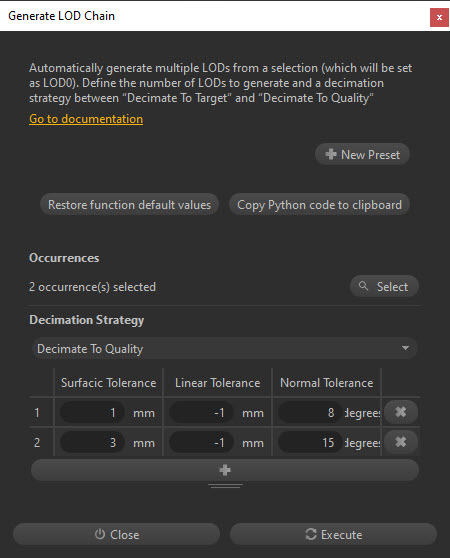
The user can choose the decimation strategy to generate the LODs, between Decimate To Quality and Decimate To Target.
Parts are renamed with a suffix (
\LODn
) to fit the naming convention handled by most game engines to automatically apply LOD behaviors.
Note
  • This scenario works for meshes only (requires the selected parts to be tessellated first).
  • More information about LODs can be found in the Unity documentation.

How To

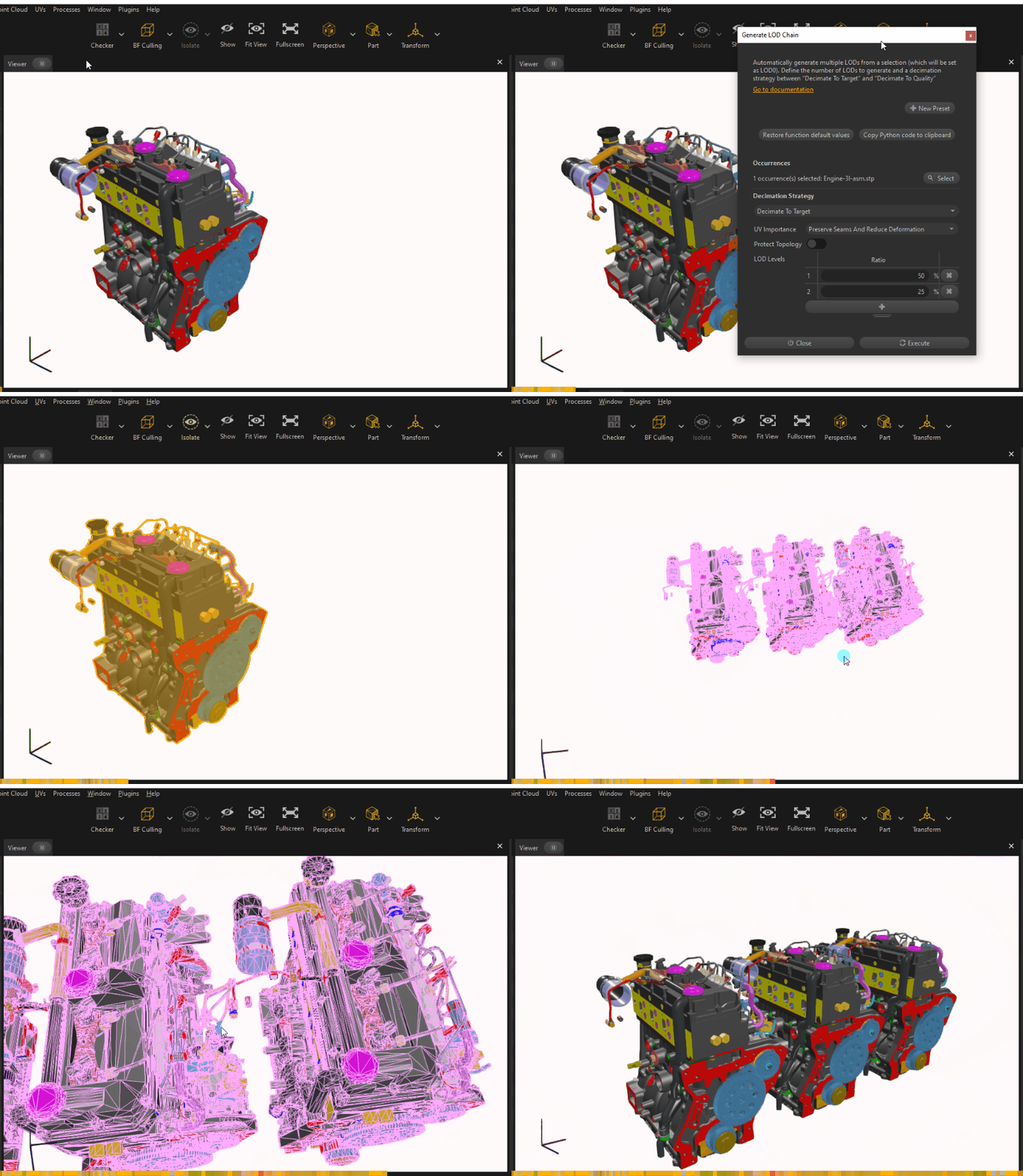
Generate LOD Chain animation
  1. Select the portion of the hierarchy for which you wish to create LODs (a group of parts or a root node).
  2. Launch the Generate LOD Chain feature from the Optimize Mesh menu (or using the Python command in a script).
  3. Choose the decimation strategy, between Decimate To Quality and Decimate To Target.
  4. Define the number of LODs generated by adding or removing rows in the table.
  5. Fine-tune the default values if necessary.
  6. Click
    Execute
    : the process is launched and for each part in the Product Structure (hierarchy):
    1. A group occurrence (or assembly occurrence in Asset Transformer Studio vocabulary) is created with the name of the Part.
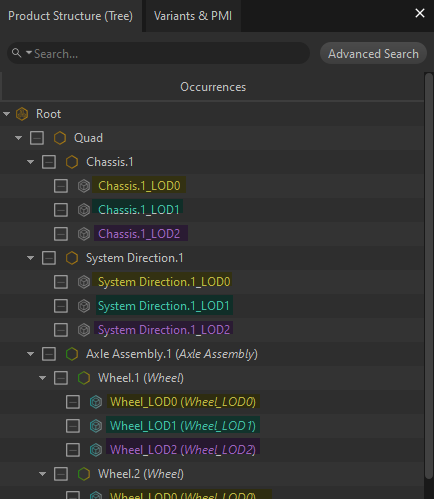
    2. The Part is cloned in the generated group as many times as the number of LODs defined as input, with the following structure:
      • PartName
        • PartName\LOD0
        • PartName\LOD1
        • PartName\LODn
    3. Each LOD group is decimated using the chosen strategy and the input values for the LOD: all the parts of the LODn are selected and processed together.
      Note
      When the decimation strategy chosen is Decimate To Target, the whole selection of parts is taken into account to reach the targeted polycount (not each individual part's polycount will reach the desired target). More information about the algorithm behavior can be found here.
    4. The result is a hierarchy as below:
      LOD Chain result

Copyright © 2026 Unity Technologies
LegalPrivacy PolicyCookiesDocumentation Terms of UseDo Not Sell or Share My Personal InformationYour Privacy Choices (Cookie Settings)

"Unity", Unity logos, and other Unity trademarks are trademarks or registered trademarks of Unity Technologies or its affiliates in the U.S and elsewhere (more info here). Other names or brands are trademarks of their respective owners.

Some pages are machine-translated for convenience, and may contain inaccuracies. In the event of conflicting information, the English version is authoritative.

  • On this page
    • Description

    • How To