General Information
Important information about Asset Transformer Studio's core technology and general behavior
Read time 2 minutesLast updated 9 hours ago
Find below important information about Asset Transformer Studio core technology and its general behavior.
For definitions of important terms, see the Glossary, and other sections in the Data Preparation Fundamentals section.
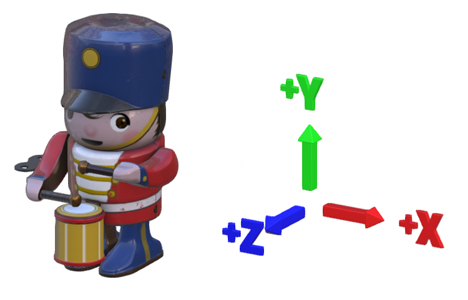
Coordinate system
Asset Transformer Studio uses a right-handed coordinate system, it defines +Y as up, +Z as forward, and -X as right. The front faces +Z.
Units
The units for all linear distances are millimeters.
The unit for angles is degrees.
Functions behavior
Many functions require entities as input to work, whether it is a list of one or more occurrences, materials, components, images, etc.
For example, the Tessellate function requires a list of occurrences to process: all BRep geometries contained in that list will be tessellated.
For functions that require a list of occurrences or a root occurrence, the user can define the node of the scene as the input for these functions.
RootIn that case, all the occurrences of the scene will be processed, whether they are visible or not (the full hierarchy is parsed).
Export
Asset Transformer Studio can export 3D models (and textures) in many 3D file formats (see the whole list in Supported File Formats).
More information in the page Exporting Files.
Textures
When textures/images are imported in Asset Transformer Studio (through the import of a 3D model, or directly importing an image file in the Texture Editor), they are actually imported and stored as a raw image (which can cause the .pxz scene file to be heavy).
More information in the page Exporting Textures.
Materials and textures deletion
When deleting a model from the scene using the Viewer or the Product Structure (Tree), materials and textures are not deleted along with it.
They need to be manually deleted using the Material Editor and the Texture Editor, or using functions like Clear Unused Materials and Clear Unused Textures.