Documentation

​
​

Development

User Acquisition

Monetization

Industry

Asset Transformer Studio

2026.5.0

Supported
​

User Manual

Python API

Changelog

Asset Transformer Studio

2026.5.0

Supported
​

​
​
Get started
  • About Asset Transformer Studio
  • Getting started
  • Additional Resources
User Interface
  • Overview
  • Menu Bar
  • Toolbars
  • Window
  • Customizing the User Interface
Data Preparation Fundamentals
  • Overview
  • General Information
  • Typical Data Preparation Workflow
  • About 3D Models Types
  • About the Product Structure (Tree)
  • About Occurrences
  • About Instances & Prototypes
  • About Face and Vertex Normals
  • About UVs
  • About Tessellation
  • About Decimation
  • About Animation
  • Glossary
Working With Asset Transformer Studio
  • Overview
  • Videos and Tutorials
  • Supported File Formats
  • Importing Files
  • Exporting Files
  • Scripting With the Python API
  • Interrupting a Process
  • Plugins
  • Errors in Asset Transformer Studio
Python API Reference
  • Overview
Changelog
  • Changelog
  1. Asset Transformer Studio
  2. Data Preparation Fundamentals

About 3D Models Types

The difference between CAD and polygonal 3D models in Asset Transformer Studio
Read time 2 minutes
Last updated 16 hours ago

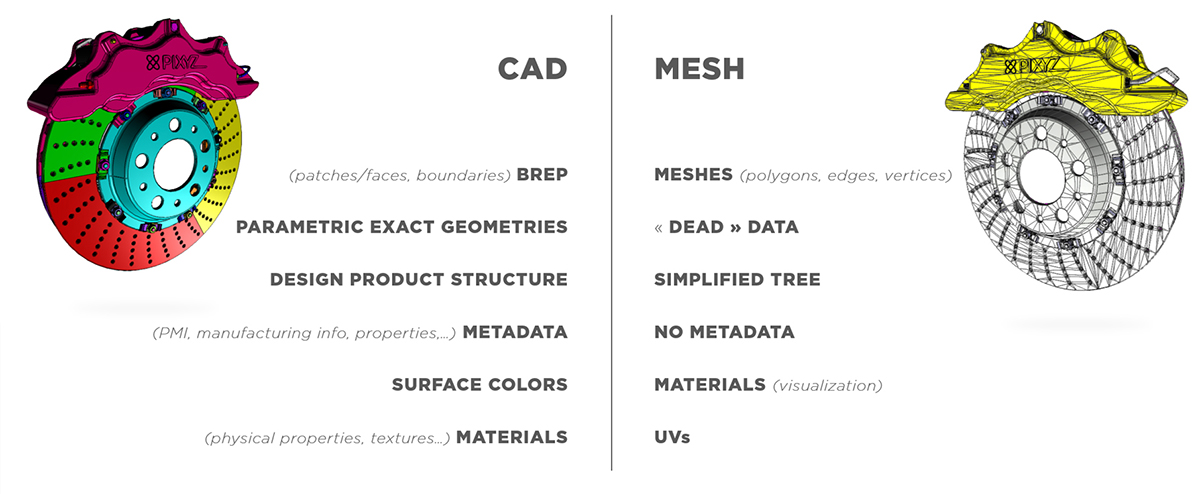
CAD vs Mesh
CAD models inherited from CAD software (CATIA, NX, SolidWorks, Alias, STEP…) are not tessellated. They contain exact parametric geometries, also called BRep, NURBS, CSG…
A CAD body (closed volume) or CAD surface (open shell surface) is composed of CAD faces (also called patches), delimited by boundaries (see Glossary).
Note
Useful links about CAD vocabulary: CAD, BRep, NURBS, PMI, CAD Data Exchange.
To be displayed in a 3D application, CAD faces need to be translated into tessellated surfaces, also called meshes.
A mesh is composed of multiple connected polygons, or triangles (1 polygon generally equals 2 coplanar triangles), forming a discretized geometry that is understandable by a GPU, to be rendered in a 3D application.
Moreover, CAD models can contain additional engineering and design data (Metadata, PMI…), which can be very useful to perform a targeted data preparation process based on targeted properties.
DCC software (Maya, 3DS Max, Blender, Modo…) natively create tessellated geometries (often referred to as polygonal models), which can be exported as FBX files for example, to be reimported in Asset Transformer Studio for further optimization.
Note that these meshes often come with attributes like normals and UVs (texture coordinates used to display textures on meshes), which can either be kept or recreated in Asset Transformer Studio.
Note
To learn about a mesh and its attributes, have a look at the page Anatomy of a Mesh in Unity documentation! See also Polygon Mesh and About Face and Vertex Normals.

Related topics

  • Supported File Formats
  • About the Product Structure (Tree)
  • About Tessellation
  • About Decimation
  • About Face and Vertex Normals

Copyright © 2026 Unity Technologies
LegalPrivacy PolicyCookiesDocumentation Terms of UseDo Not Sell or Share My Personal InformationYour Privacy Choices (Cookie Settings)

"Unity", Unity logos, and other Unity trademarks are trademarks or registered trademarks of Unity Technologies or its affiliates in the U.S and elsewhere (more info here). Other names or brands are trademarks of their respective owners.

Some pages are machine-translated for convenience, and may contain inaccuracies. In the event of conflicting information, the English version is authoritative.

  • On this page
    • Related topics