Documentation

​
​

Development

User Acquisition

Monetization

Industry

Asset Transformer Studio

2026.5.0

Supported
​

User Manual

Python API

Changelog

Asset Transformer Studio

2026.5.0

Supported
​

​
​
Get started
  • About Asset Transformer Studio
  • Getting started
  • Additional Resources
User Interface
  • Overview
  • Menu Bar
  • Toolbars
  • Window
  • Customizing the User Interface
Data Preparation Fundamentals
  • Overview
  • General Information
  • Typical Data Preparation Workflow
  • About 3D Models Types
  • About the Product Structure (Tree)
  • About Occurrences
  • About Instances & Prototypes
  • About Face and Vertex Normals
  • About UVs
  • About Tessellation
  • About Decimation
  • About Animation
  • Glossary
Working With Asset Transformer Studio
  • Overview
  • Videos and Tutorials
  • Supported File Formats
  • Importing Files
  • Exporting Files
  • Scripting With the Python API
    • Getting Started With Scripting
    • Creating and Using Scripts
    • Sample Scripts
    • Basic Structures in a Scene
    • Product Structure Management
    • Filter Expressions
  • Interrupting a Process
  • Plugins
  • Errors in Asset Transformer Studio
Python API Reference
  • Overview
Changelog
  • Changelog
  1. Asset Transformer Studio
  2. Working With Asset Transformer Studio
  3. Scripting With the Python API

Basic Structures in a Scene

Core object types and scene structures used in Asset Transformer Studio Python scripting
Read time 2 minutes
Last updated a day ago

To get started, check also the following topics about concepts and vocabulary:
  • About the Product Structure (Tree)
  • Glossary

Object types

  • All objects are called
    entities
  • In Python scripting, an entity is defined by a unique numerical identifier, or
    ID
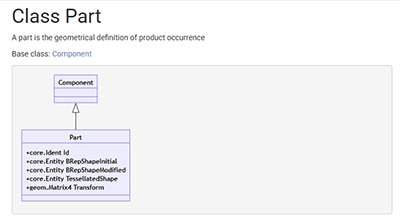
  • The API Reference shows inheritance of entity types.
For example, a part is inherited from component, so if a function wants a
component
parameter you can give it a
part
:
Entity type inheritance

Scene occurrences

  • Product Structure / Scene nodes are Occurrences
  • An occurrence can have child occurrences
  • An occurrence has Properties:
    • Name
    • Transform
    • Material
    • Visible
  • An occurrence owns components (maximum one of each type)
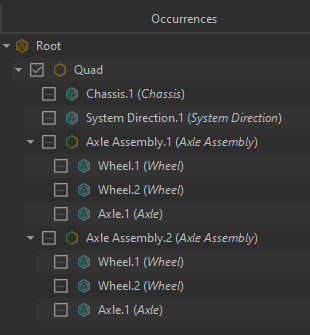
Occurrence structure

Scene components

List of component types:
  • Part
  • PMI
  • Light
  • Metadata
  • Variant
  • Animation
  • Joint
  • SubPart Material

Prototyping

  • Each occurrence can have a prototype, a prototype is also an occurrence
  • A prototype is a kind of pattern
  • An occurrence can override properties of its prototype occurrence
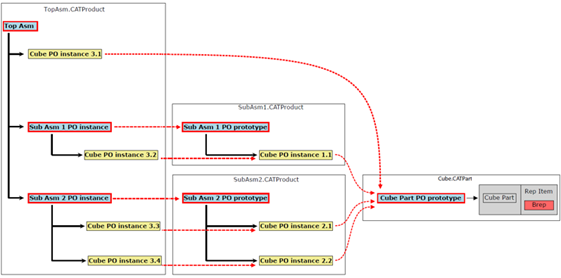
Prototype example
See also: About Instances & Prototypes

Scene Part

  • A part contains geometry, contained in a shape
  • A part may contain one or two shapes:
    • A
      BRep Shape
      with CAD representation
    • A
      Tessellated Shape
      with Mesh representation
  • The active shape is the tessellated shape if it exists, the BRep shape otherwise.
  • A part has a local transformation matrix
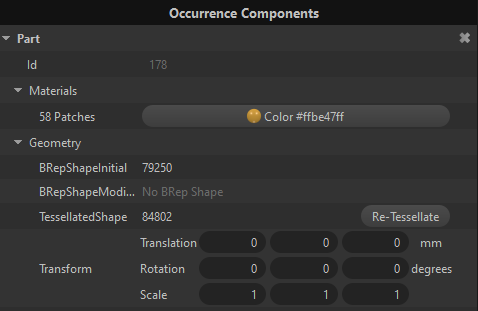
Part structure

Common functions for scene handling

Get the type of an entity as a String:
core.getEntityTypeString(entity)
Get/Set a property value (all property values are Strings):
nameValue = core.getProperty(entity, "Name") core.setProperty(entity, "Name", "NameValue")
List available properties on an entity:
core.listProperties(entity)

Other Python examples

Occurrence list with the root:
[scene.getRoot()]
Occurrence list with all parts:
scene.getPartOccurrences()
Occurrence list with selection:
scene.getSelectedOccurrences()
All occurrences:
scene.findOccurrencesByProperty('Name', '.*')

Related Topics

  • Product Structure Management
  • Scripting With the Python API

Copyright © 2026 Unity Technologies
LegalPrivacy PolicyCookiesDocumentation Terms of UseDo Not Sell or Share My Personal InformationYour Privacy Choices (Cookie Settings)

"Unity", Unity logos, and other Unity trademarks are trademarks or registered trademarks of Unity Technologies or its affiliates in the U.S and elsewhere (more info here). Other names or brands are trademarks of their respective owners.

Some pages are machine-translated for convenience, and may contain inaccuracies. In the event of conflicting information, the English version is authoritative.

  • On this page
    • Object types

    • Scene occurrences

    • Scene components

    • Prototyping

    • Scene Part

    • Common functions for scene handling

    • Other Python examples

    • Related Topics