Documentation

​
​

Development

User Acquisition

Monetization

Industry

Asset Transformer Studio

2026.5.0

Supported
​

User Manual

Python API

Changelog

Asset Transformer Studio

2026.5.0

Supported
​

​
​
Get started
  • About Asset Transformer Studio
  • Getting started
  • Additional Resources
User Interface
  • Overview
  • Menu Bar
  • Toolbars
  • Window
  • Customizing the User Interface
Data Preparation Fundamentals
  • Overview
  • General Information
  • Typical Data Preparation Workflow
  • About 3D Models Types
  • About the Product Structure (Tree)
  • About Occurrences
  • About Instances & Prototypes
  • About Face and Vertex Normals
  • About UVs
  • About Tessellation
  • About Decimation
  • About Animation
  • Glossary
Working With Asset Transformer Studio
  • Overview
  • Videos and Tutorials
  • Supported File Formats
  • Importing Files
  • Exporting Files
    • Exporting Textures
    • Exporting GLB With Draco Compression
    • Export Unity Prefab
    • Upload Scene To Unity Asset Manager
  • Scripting With the Python API
  • Interrupting a Process
  • Plugins
  • Errors in Asset Transformer Studio
Python API Reference
  • Overview
Changelog
  • Changelog
  1. Asset Transformer Studio
  2. Working With Asset Transformer Studio
  3. Exporting Files

Export Unity Prefab

How to export Unity Prefab files from Asset Transformer Studio
Read time 1 minute
Last updated 9 hours ago

Export Unity Prefab
In order to bridge the gap between the CAD world and Unity Editor to unlock Real-Time 3D content creation, Asset Transformer Studio natively supports the export of Unity Prefab files.
In Unity, a Prefab is a special type of component that allows fully configured GameObjects to be saved in the Project for reuse.
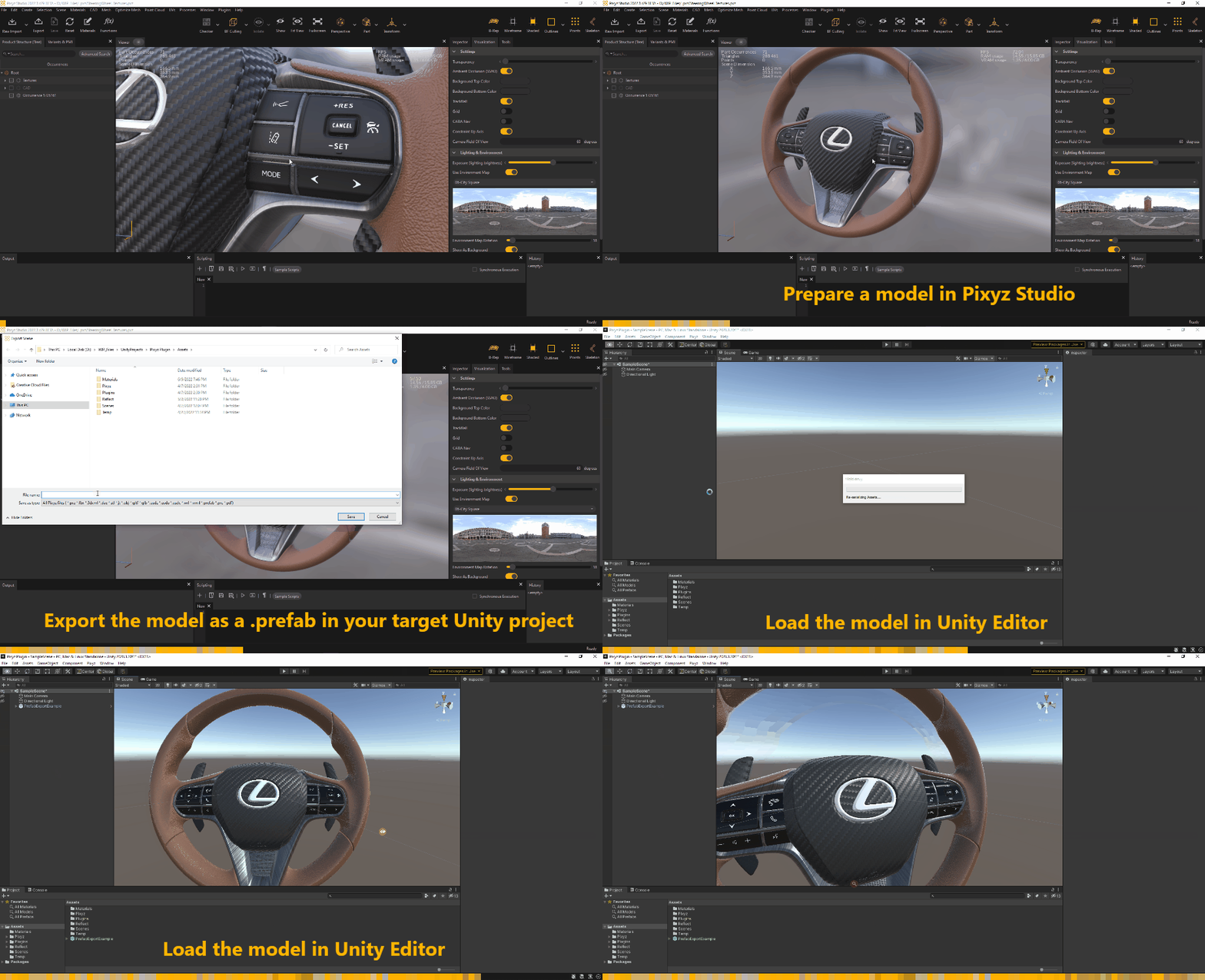
This export capability provides a streamlined workflow from CAD/3D models to Unity Editor:
  1. Import and aggregate CAD/3D models in Asset Transformer Studio.
  2. Prepare and optimize them using the full extent of Asset Transformer Studio features.
  3. Export as a .prefab file, directly in the targeted Unity Editor project.
Note
To import multiple 3D models optimized with Asset Transformer Studio in a runtime app built with Unity, the recommended solution is to use glTF files as pivot files, generated with Asset Transformer SDK: more information here.

Supported features

  • Full Product Structure (hierarchy)
  • Conversion to Unity's Coordinate System (Y-up, left-handed)
  • Non-visible occurrences exported (kept non-visible)
  • Instances preserved
  • Meshes (triangulated; normals, UVs (channels 0 and 1 only) and tangents exported)
  • Materials (converted to Unity Standard material type)
  • Textures (embedded as raw images)

Not exported/supported

  • Lines, points and BRep geometries (give empty GameObjects if existing)
  • Vertex colors
  • Metadata or Custom Properties
  • Animation
  • PMI/Variants/Views/Cameras

Copyright © 2026 Unity Technologies
LegalPrivacy PolicyCookiesDocumentation Terms of UseDo Not Sell or Share My Personal InformationYour Privacy Choices (Cookie Settings)

"Unity", Unity logos, and other Unity trademarks are trademarks or registered trademarks of Unity Technologies or its affiliates in the U.S and elsewhere (more info here). Other names or brands are trademarks of their respective owners.

Some pages are machine-translated for convenience, and may contain inaccuracies. In the event of conflicting information, the English version is authoritative.

  • On this page
    • Supported features

    • Not exported/supported