Bid management for cost per engagement ad sets
Manage bids in your cost-per-engagement (CPE) campaigns by adding new bids to existing offers, and adjusting them manually or through CSV download and upload.
Read time 4 minutesLast updated 2 months ago
After you create a CPE campaign and add ad sets to it, you can adjust your ad set bids as needed.
Single ad set
- Log into the Tapjoy Dashboard and navigate to the Campaigns tab.
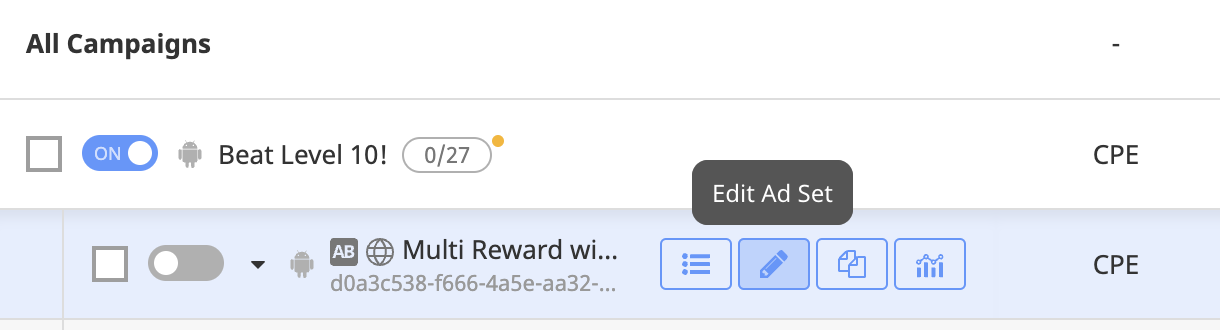
- Select the edit icon on your selected Ad set to open the Ad set editor page.
- Navigate to the Budget section on the Ad set editor to adjust your CPE/Multi-reward event bids.
Multiple ad sets
- Log into the Tapjoy Dashboard and navigate to the Campaigns tab.
- Select Bid Manager to open the CSV Bid Manager.
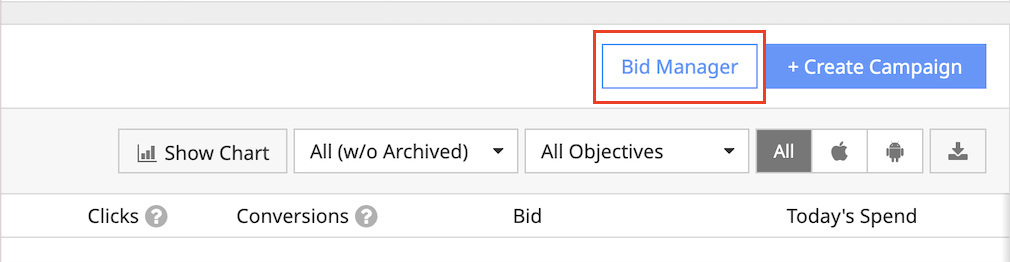
- Toggle between the Download and Upload pages to adjust your CPE/Multi-reward event bids.
Per app bids
Per-App bidding (PAB) allows advertisers to bid a different amount per publisher app. This model enables advertisers to further optimize their CPE campaigns and benefit by investing more in high performing sources.
Adding per app bids via ad set editor
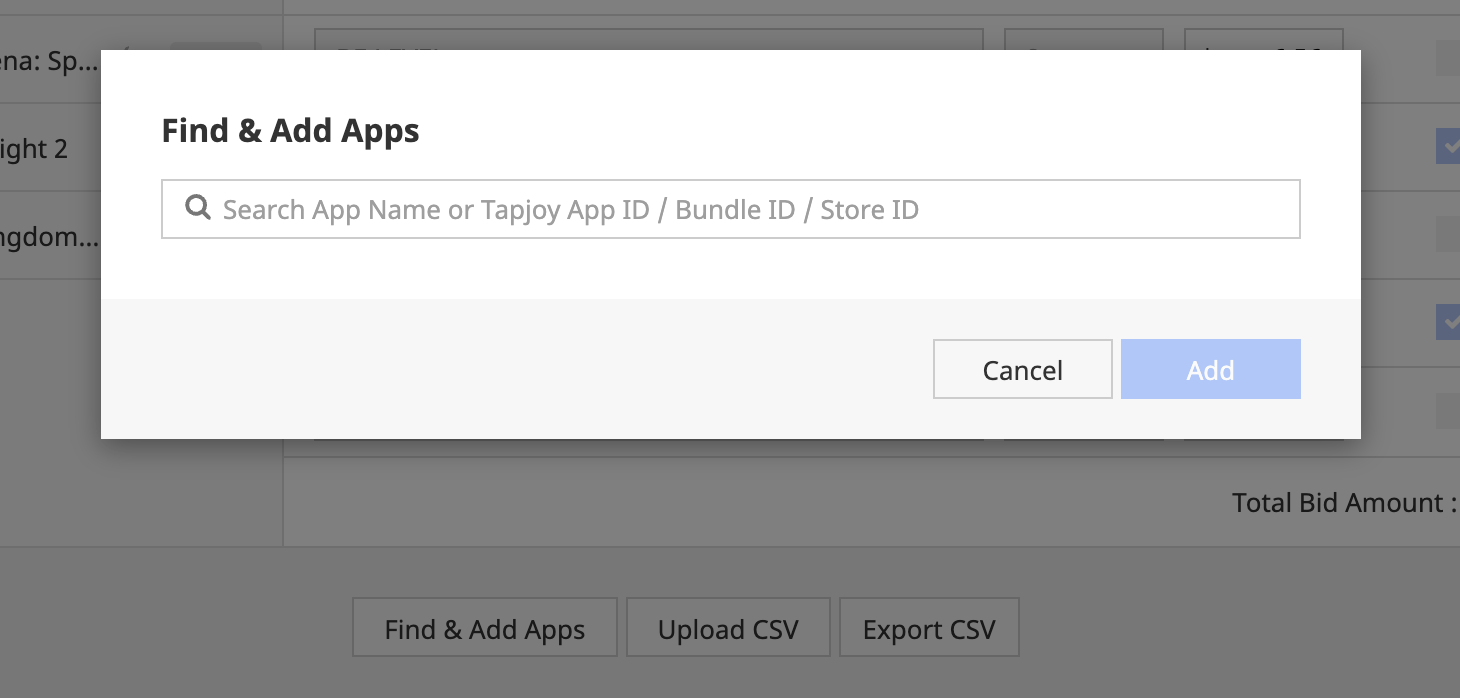
Adding a bid for a publisher app can be done by using a graphical user interface using the Find & Add Apps button. This brings up a type-to-search experience in which you can search for apps by app name or app ID.
Contact your account manager if you want to set per app bids for your ad set but cannot find this feature on your dashboard.
Default bid
All ad sets must have a default bid. This default bid is used for every publisher app that does not have a specific corresponding per-app bid.
CSV bid management
Campaign manager
The CSV Bid Manager within the campaign manager allows you to adjust bids for multiple Ad sets via a single CSV. Using advanced filtering capabilities you can download complex multi-reward/per-app-bid setups and upload changes via a single file. We recommend the following user flow for updating bids:
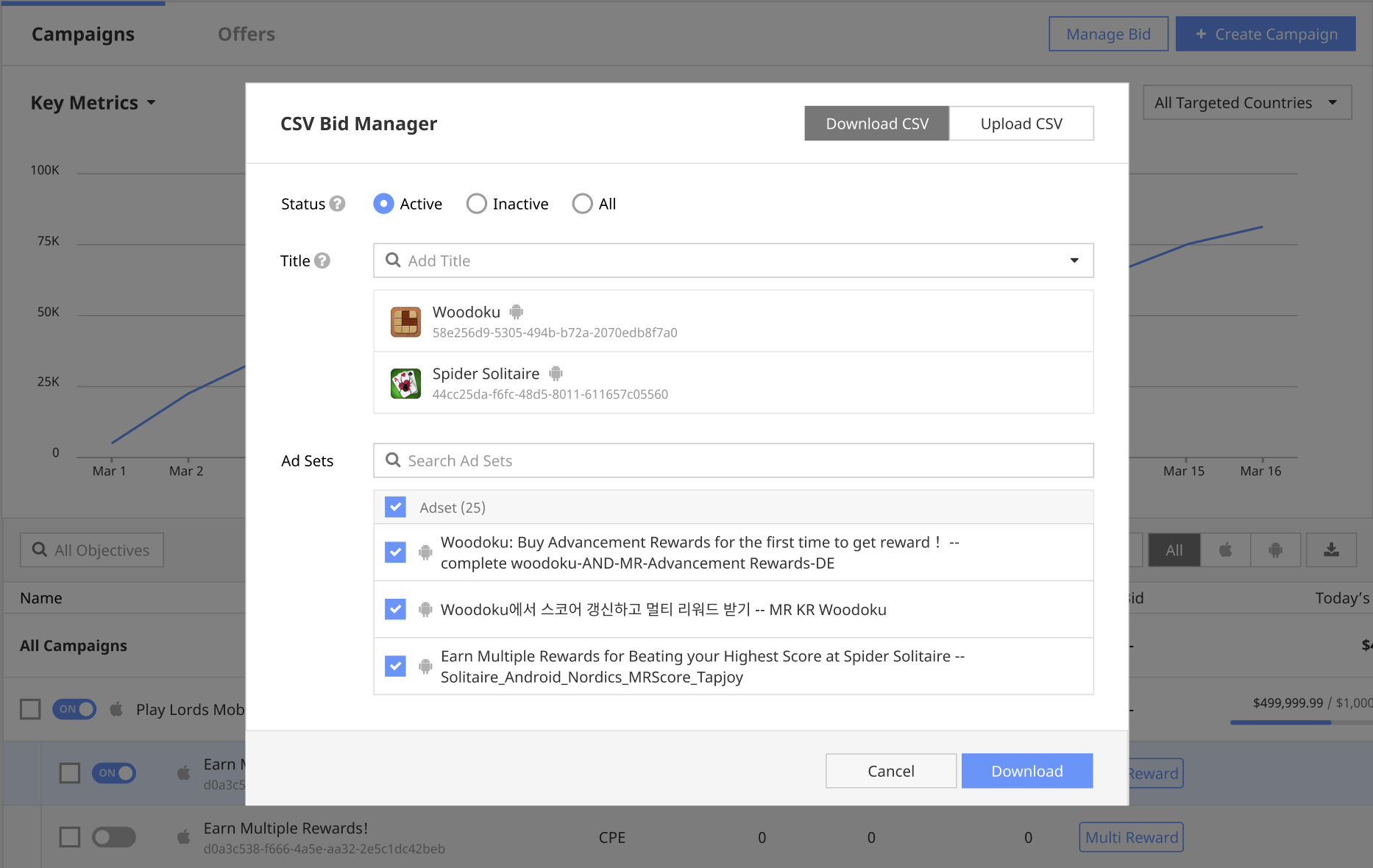
- Select Bid Manager on the campaign manager page.
- Filter Ad sets you want to apply changes for by Ad set Status, Advertising app/ID, or Adset Name/ID.
- Export the current bid settings for selected Ad sets using the Download button.
- Duplicate this file before making your changes. Or, get your other bid CSV sheet ready.
- Upload the new bids, correcting any errors that may arise.
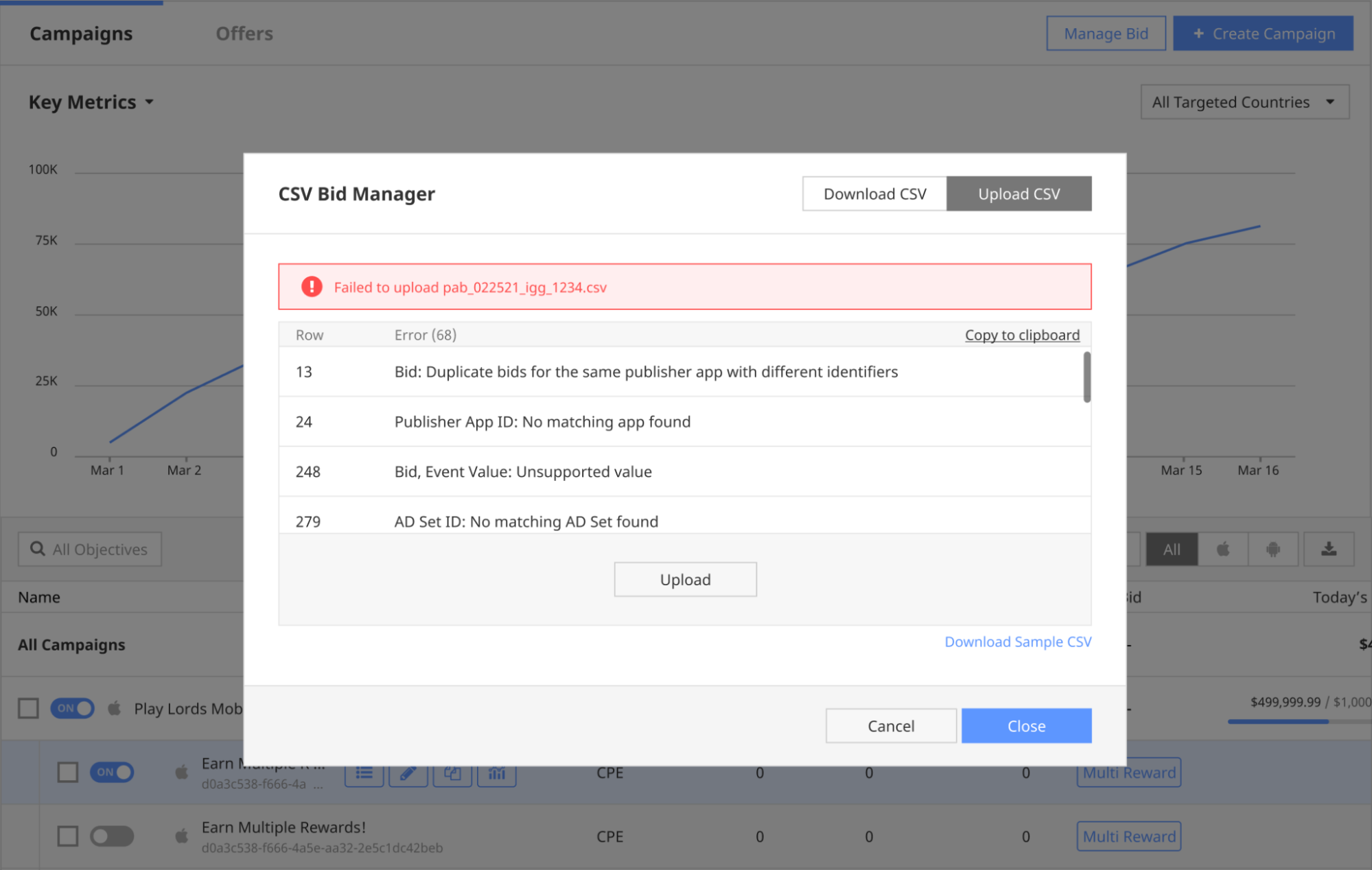
Using this flow, you'll always have your last set of bids before the recent changes in case you want to "undo" or go back to your prior bid setup.
Downloading or uploading your bid sheet
We’ve tried to make the CSV export as flexible as possible. This includes supporting multiple types of app identifiers in your download file such as Store ID, Bundle ID, internal App IDs and Hashed IDs.
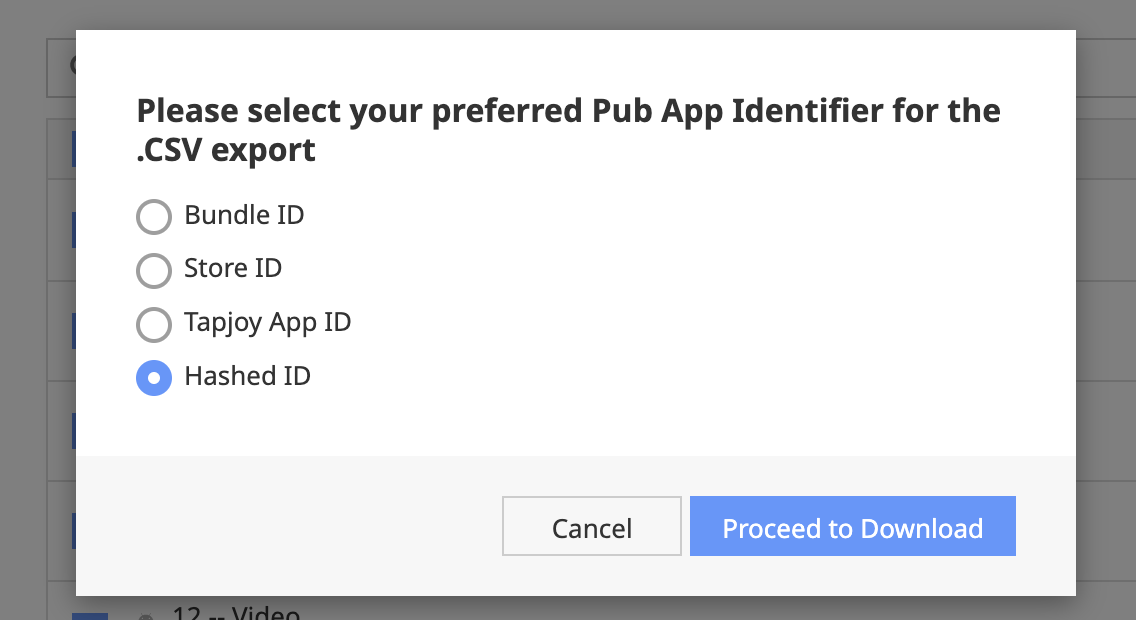
Flexible app identifiers are supported in the CSV upload as well. However, using multiple identifiers within one bid sheet increases the likelihood of duplicate rows, while also making identifying these duplicates more difficult.
We have further simplified the upload process by introducing the following features:
Make explicit bid changes
This feature gives you the ability to specify only those bid rows in your upload file that you want to change pricing for.
For example, let’s say you have a complex Per App Bid setup containing bids for 25 publisher apps, but you want to change pricing for only 2 publisher apps. You can upload a file with bid details for only those 2 apps, therefore saving a ton of time in formatting and reducing the risk of manual errors.
Upload mixed bid rows
Did you forget to duplicate the file and you don’t quite remember the order of the complex multi-reward setup?
We’ve got you covered! The order of rows in your upload file does not need to be exactly the same as your download file. Mix them up, and the system will still be able to process your file.
Deleting per-publisher app bids
You can delete per app bid(s) by inserting the value “DEFAULT” in the bid column. Note that you cannot make structural changes to multi-reward setups, and will need to contact your account manager for that. However, you can add/delete per app bids on your own.
Common errors
The most common error is duplicate rows - that is, more than one row specifying the same Ad set, publisher app and multi-reward event. There are also minimum and maximum bid limits enforced by the system that help minimize manual errors in pricing.
Ad set editor
There is no Undo button for bid changes! Therefore, we recommend the following user flow for updating bids via the Ad set editor page:
- Export the current bid settings using the Export CSV button.
- Duplicate this file before making your changes. Or, get your other bid CSV sheet ready.
- Upload the new bids, correcting any errors that may arise.
Exporting a sample file to get started
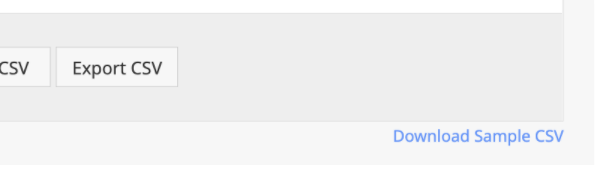
If you are starting from scratch, it may help to start by editing the sample CSV file, or even looking at it to learn the format can be helpful. Select the Download Sample CSV link in the bottom-right corner of the bid manager interface.
Download/uploading your bid sheet
Similar to the Campaign Manager, the Ad editor page supports flexible app identifiers in the CSV download/upload.
The upload process may time out if your bid sheet has more than 1,000 rows. If this is the case, use the Bid Manager within Campaign Manager or contact your Account Manager and we can work with our engineering team to manually process these large files.
Common errors
The most common error is duplicate rows - that is, more than one row specifying the same publisher app and multi-reward event. There are also minimum and maximum bid limits enforced by the system that help minimize manual errors in pricing.
Bid recommendations and best practices
Raising bids to boost ranking
We recommend raising bids by at least 10% to noticeably improve ranking in a given publisher app.
Lowering bids based on ROAS
If your analysis shows that certain publisher apps are driving users with a lower Return on Ad Spend (ROAS) than the rest, lowering your bids can be an effective way to improve ROAS without the potentially significant harm to campaign volume that blocklisting may have.