Documentation

​
​

Development

User Acquisition

Monetization

Industry

Asset Transformer SDK

2026.1

Supported
​

User Manual

Python API

C# API

Changelog

Discussions

Asset Transformer SDK

2026.1

Supported
​

​
​
Get started
  • System requirements
  • Licensing
  • Setup
  • Migrate from Scenario Processor
Framework
  • Framework
  • Preferences
Input/output files
  • Supported formats
  • Import files
  • Export files
  • Export textures
  • CAD vs Mesh
Scene
  • Product structure
  • Occurrence
  • Component
  • Material
  • Image
Algorithms
  • CAD
  • Healing
  • Optimization
  • Combine and bake
  • Reconstruction
    • Proxy mesh
    • Dual contouring
    • Retopologize
    • Decompose into convex meshes
    • Explode into connected subsets
    • Create occlusion meshes
  • UVs
Viewer
  • Viewer
Pixyz UI
  • Setup
  • Overview
  • Create a custom UI
Guidelines
  • Data preparation
  • Process point clouds
Debug and diagnose
  • Log files
  • Debug best practices
Other
  • Samples
  • Glossary
  1. Asset Transformer SDK (ex Pixyz)

Decompose convex meshes

Use this feature to create a new set of convex meshes that approximate the selected mesh.
Read time 1 minute
Last updated 9 months ago

API function: algo.convexDecomposition
Use this feature to create a new set of convex meshes that approximate the selected mesh.
An example of use is convex mesh colliders.
The feature is driven by two parameters:
  • The maximum number of convex meshes to be created
  • The maximum number of vertices per convex mesh
This example shows how you can use this feature to solve 3D physics problems:
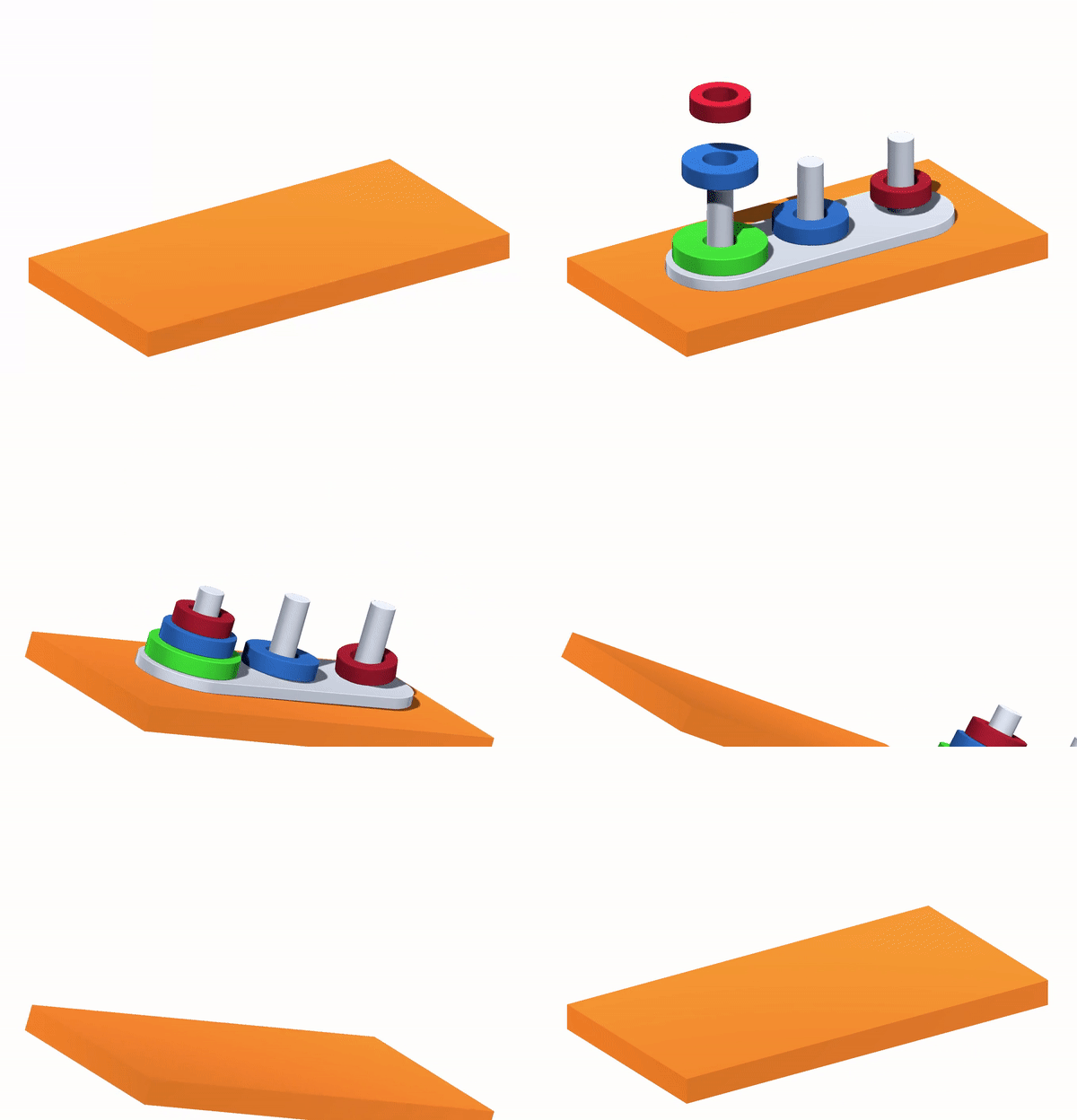
A ring toss game slides on a sloping surface.
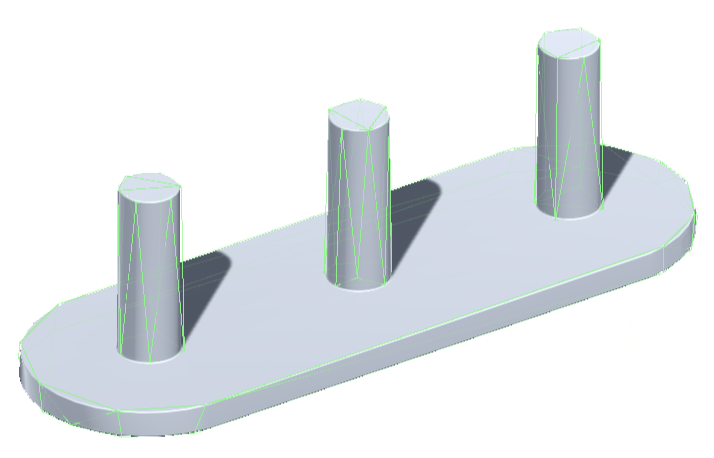
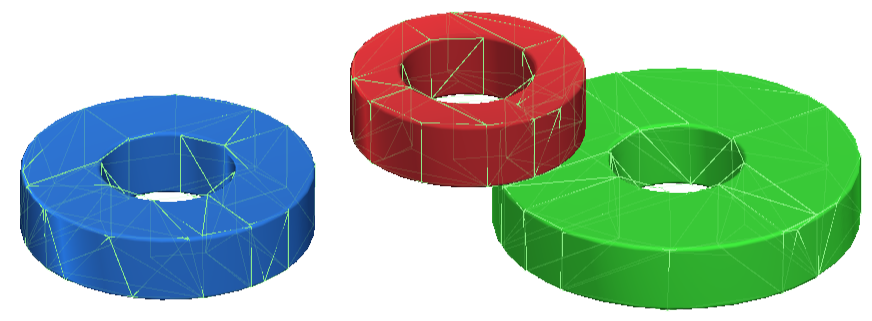
Without processing, classic 3D physics engines can't simulate the movement of the rings. Because of concavity, the pillars and the rings require specific processing:
  1. The base must be decomposed into a set of four convex meshes:
  1. Each ring must be decomposed into enough convex meshes for the simulation to look realistic:
Tip
A convex decomposition with V vertices and T triangles always satisfies the Euler characteristic:
V = 2 + T/2
You can use this formula to show the triangle count to users.

Copyright © 2026 Unity Technologies
LegalPrivacy PolicyCookiesDocumentation Terms of UseDo Not Sell or Share My Personal InformationYour Privacy Choices (Cookie Settings)

"Unity", Unity logos, and other Unity trademarks are trademarks or registered trademarks of Unity Technologies or its affiliates in the U.S and elsewhere (more info here). Other names or brands are trademarks of their respective owners.

Some pages are machine-translated for convenience, and may contain inaccuracies. In the event of conflicting information, the English version is authoritative.


    Report a problem with this page