ドキュメント

​
​

Development

User Acquisition

Monetization

産業

Asset Transformer SDK

2026.4

サポート対象
​

User Manual

Python API

C# API

Changelog

Discussions

Asset Transformer SDK

2026.4

サポート対象
​

このページは選択した言語では使用できません。
​
​
Get started
  • System requirements
  • Licensing
  • Setup
  • Migrate from Scenario Processor
Framework
  • Framework
  • Preferences
Input/output files
  • Supported formats
  • Import files
  • Export files
  • Export textures
  • CAD vs Mesh
Scene
  • Product structure
  • Occurrence
  • Component
  • Material
  • Image
Algorithms
  • CAD
  • Healing
  • Optimization
  • Combine and bake
  • Reconstruction
  • UVs
Viewer
  • Viewer
Pixyz UI
  • Setup
  • Overview
  • Create a custom UI
Guidelines
  • Data preparation
  • Process point clouds
Debug and diagnose
  • Log files
  • Debug best practices
Other
  • Samples
  • Glossary
  1. Asset Transformer SDK (ex Pixyz)

Framework

Learn about Pixyz's internal framework, including its C++ architecture, supported data types, modules, and entity-based system.
読み終わるまでの所要時間 1 分
最終更新 3ヶ月前

The internal structure of Pixyz is built to handle different types of product structures, geometry types and heavy algorithms thanks to a custom made and extensible architecture. Pixyz is entirely coded in C++. For high precision, Pixyz computes numbers in the double-precision floating-point format for most of its data structures.
The internal structure of Pixyz supports, among others, these data types:
  • BRep shapes
  • Meshes
  • Point Clouds
  • PMI
  • Variants
  • Materials
  • Images
  • ...

Modules

Pixyz API is organized into functional libraries that are referred to as modules:
  • Algo
  • CAD
  • Core
  • Geom
  • IO
  • Material
  • Polygonal
  • Scene
  • Unity
  • View

Entities

Pixyz API isn't strictly speaking object-oriented. Pixyz works with references to entities inside the framework. These references are IDs of
unsigned int
type. This processing simplifies the handling of objects that live within the framework, but requires to explicitly create or gather objects, and then to destroy them.
This diagram shows a simplified view of Pixyz's entity structure:
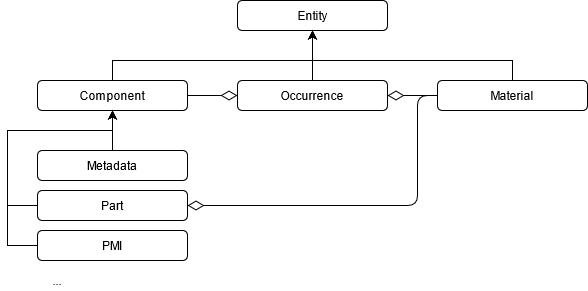
diagram
Entities are abstract objects that are defined by an unsigned integer ID. All occurrences, materials, and components have an ID property. Each ID is unique. Most functions take an ID or a list of IDs as input. Some functions can take entities of all types as input. In other words, you can indiscriminately use these functions to access occurrences, materials, and parts. Examples are these functions:
  • core.getProperty
  • core.setProperty
  • core.listProperties

Copyright © 2026 Unity Technologies
法規事項プライバシーポリシークッキーDocumentation Terms of Use私の個人情報を販売または共有しないプライバシーに関する選択 (クッキー設定)

"Unity" の名称、Unity のロゴ、およびその他の Unity の商標は、米国およびその他の国における Unity Technologies またはその関係会社の商標または登録商標です (詳しくはこちら)。その他の名称またはブランドは該当する所有者の商標です。

一部のページは利便性向上のため機械翻訳を使用しており、内容に不正確な表現が含まれる場合があります。内容に齟齬または不一致が生じた場合は、英語版を正本とします。

  • このページ
    • Modules

    • Entities


このページの問題を報告する