Get started with Unity Ads in-app bidding in Unity LevelPlay
Integrate Unity Ads in-app bidding with LevelPlay.
Read time 5 minutesLast updated 13 hours ago
To set up Unity Ads for in-app bidding in Unity LevelPlay, you can either:
- Use the automated setup, which is the recommended best practice. For more information, refer to the Unity Ads integration guide.
- Use the manual process outlined in this guide.
Manual in-app bidding setup
1. Install the required adapter version
Install a LevelPlay adapter that supports Unity Ads SDK version 4.6.1 or above for the best performance on bidding. Get the adapter from the Unity Ads Change Log.
2. Create a Bidding Placement in the Unity Monetization Dashboard
Use a Bidding Placement for third-party-mediated projects to receive the most competitive bid for your ad space. Unlike traditional waterfalls, where mediation platforms prioritize ad networks based on manual targets set by the publisher, bidding allows for a fair auction where multiple ad networks can compete in real-time for impressions. The ad network with the highest bid wins the bid request.
To create a Bidding Placement:
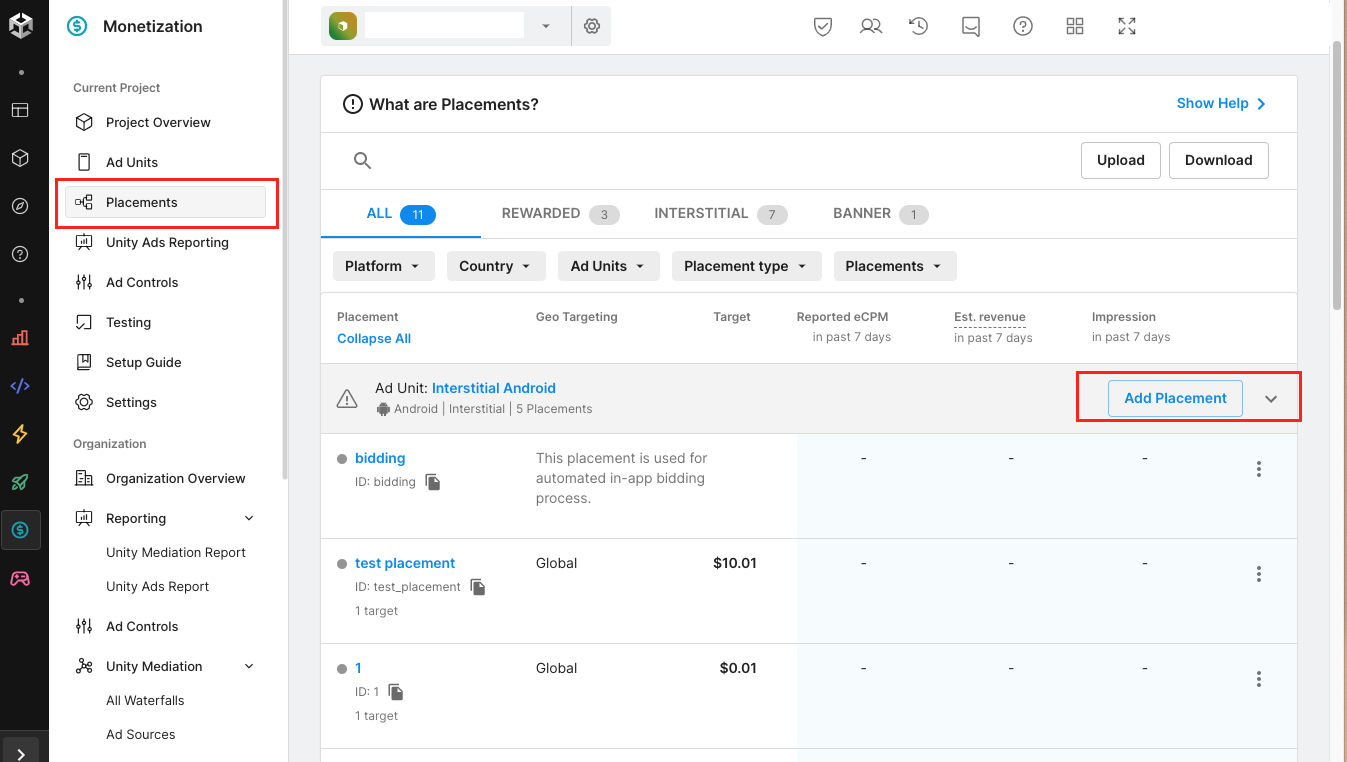
- Go to the Unity Ads monetization dashboard and select Placements > Add Placement.
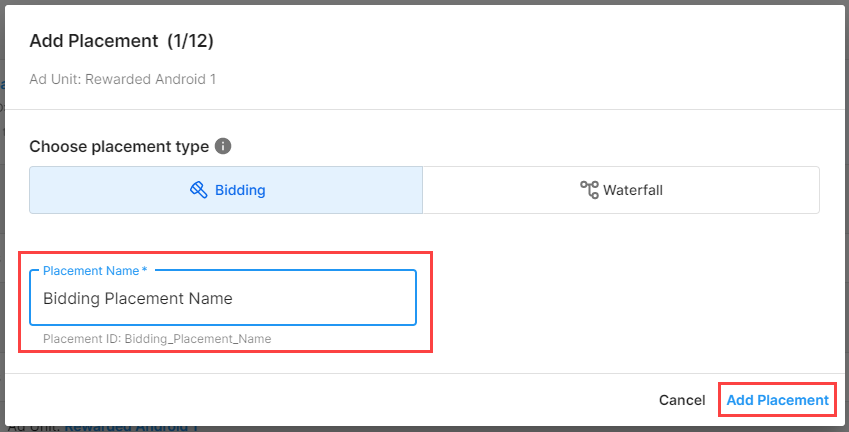
- Select Bidding and enter the Placement Name.
- Select Add Placement.
Managing Placements
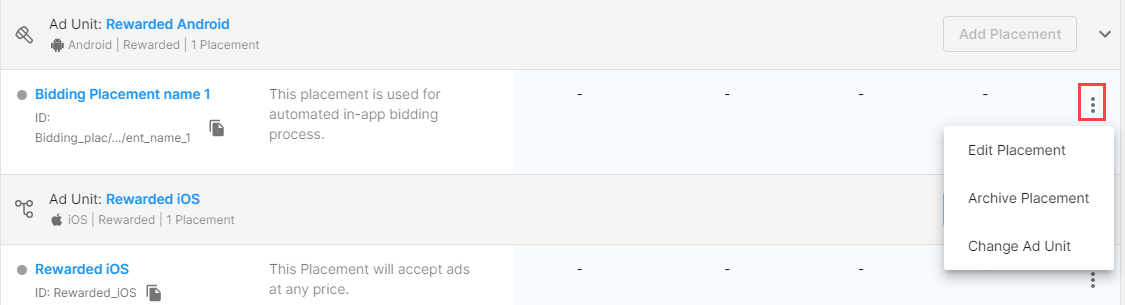
On the Placement Management page, select the more menu next to the preferred Placement to:
- Edit Placement, including Placement Name
- Archive Placement
- Change Ad Unit
Troubleshooting Placements
If a Placement doesn't switch from bidding to a traditional waterfall after you change from LevelPlay to another mediation partner, this will cause the following load error to display when trying to load a placement:
Header bidding load invocation failed: adMarkup is missing; objectId is missing
This error indicates that the and parameters are missing when requesting ads for a bidding type Ad Unit/Placement.
adMarkupobjectIdTo resolve this error, use one of the following approaches:
- Your new mediation partner supports Unity Ads bidding: Set up Unity Ads as a bidder with that partner so it sends the ad markup with each request, and check that your integration is correct. Refer to In-app bidding with Unity Ads.
- Your new mediation partner uses a waterfall: Request ads with an existing waterfall Placement ID instead of the bidding Placement ID. You can no longer create new waterfall Placements. Existing waterfall Placements continue to serve ads, but you can't edit them. Refer to Waterfall strategy for the transition timeline.
If you don't have an existing waterfall Placement, set up Unity Ads as a bidder with your new mediation partner.
3. Create a bidding instance in the LevelPlay dashboard
The Unity LevelPlay in-app bidding solution enables you to sell your ad inventory in an automated auction by allowing ad sources to bid for each impression in real time.
To create your bidding instance in the LevelPlay Dashboard, refer to How to set up in-app bidding.
4. Run a bidding test
A bidding test is an A/B test that compares the performance of your current waterfall (A) against one that includes in-app bidding (B). It helps you decide how quickly to move your remaining waterfall traffic to bidding.
To ensure your setup is correct and the test runs accurately, refer to A/B test.
Best practices for mapping ad units
When you map your ad units, consider the following:
-
To connect your placements, you must enter a bidding Placement ID from the Monetization dashboard in the bidding Placement ID field in the LevelPlay dashboard. Ensure you're entering a bidding Placement ID from Unity, not a waterfall Placement ID, or your setup fails.
-
If Unity receives a request that isn't mapped correctly, Unity fills it as an automatic placement, using the ad format signals that LevelPlay provides in the bid request. You receive fill and payment instead of a silent no-bid. Unity reports these requests as,
Automatic_Interstitial, orAutomatic_Rewarded. If you see them in your reports, find and correct the mapping errors in the LevelPlay dashboard.Automatic_Banner -
Unity doesn't support hybrid auctions that use both bidding and waterfall in the same user session. To run an A/B test, split user sessions into 100% waterfall or 100% bidding, or adopt 100% bidding from the start.