文档

​
​

Development

User Acquisition

Monetization

工业

Vivox Core SDK

Vivox Core SDK

此页面不支持所选语言。
Vivox
​
​
Vivox Core SDK
  • Overview
  • Before you begin
  • Get started
  • Release notes
  • Developer Guide
  • Reference
  • Privacy overview
  1. Vivox Core SDK documentation

Vivox SDK design

Learn about the Vivox Core client software design.
阅读时间1 分钟
最后更新于 6 个月前

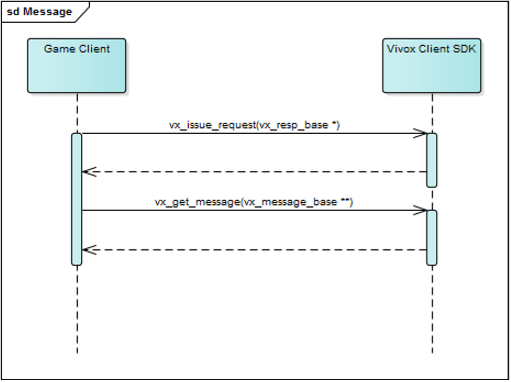
The Vivox SDK interface is based on request, response, and event messages. The game client creates request messages, fills in the fields of those messages, and sends those messages to the Vivox Client SDK by using the
vx_issue_request3()
method.
注意
vx_issue_request3()
is a non-blocking method, and you can safely call it from the game client user interface thread.
When the request completes, or when there is data available for the game client to use, the Vivox SDK makes a response message or an event message available to the game client. The game client gets access to this message by calling the
vx_get_message()
method.
注意
vx_get_message()
is a non-blocking method, and can safely call it from the game client user interface or in the game message processing loop.
After the game client has an even or response, the game client uses the information in those fields to update the game client state.
The following diagram displays how messages are communicated between the game client and the Vivox SDK.
重要
There are dozens of request/response pairs and events that are exposed by the Vivox SDK, although it is rare that the game needs to make use of all of them. For a detailed mapping of individual request and response pairs and events to functional areas, see Request, response, and event mapping to Vivox functionality.

Copyright © 2026 Unity Technologies
法律信息隐私政策CookiesDocumentation Terms of Use请勿出售或分享我的个人信息您的隐私选择(Cookie 设置)

“Unity”、Unity 徽标及其他 Unity 商标是 Unity Technologies 或其附属公司在美国和其他地方的商标或注册商标(此处查看更多信息)。其他名称或品牌是其各自所有者的商标。

为方便起见,一些页面是机器翻译的,可能包含不准确的内容。如有信息不一致的情况,以英文版本为准。


    报告此页面的问题